



January 26, 2026

110 Views

6 min read
Share


The Impact of Autonomous Vehicles on the Trucking Industry
Page Contents
Want to talk with us?
The trucking industry rarely changes overnight, but it does change when an innovation cuts risk and cost at the same time. That is why autonomous self-driving trucks are being watched so closely: once a vehicle can handle long highway miles with steady efficiency and documented reliability, dispatch, logistics, and even pricing start to shift.
Benefits of Autonomous Vehicles in Trucking
The main benefits of autonomous vehicles in trucking come from one thing: they make driving more consistent than a human can be over thousands of miles.
The first advantage is safety. Most truck crashes happen because someone was tired, distracted, or driving too fast. Autonomous systems don’t blink, don’t check their phone, and don’t push through the night when they should pull over. They brake sooner, hold safe distances better, and stay centered in the lane mile after mile. Autonomous vehicles’ consistency cuts the kinds of preventable collisions that kill thousands of people every year and cost fleets millions in claims.
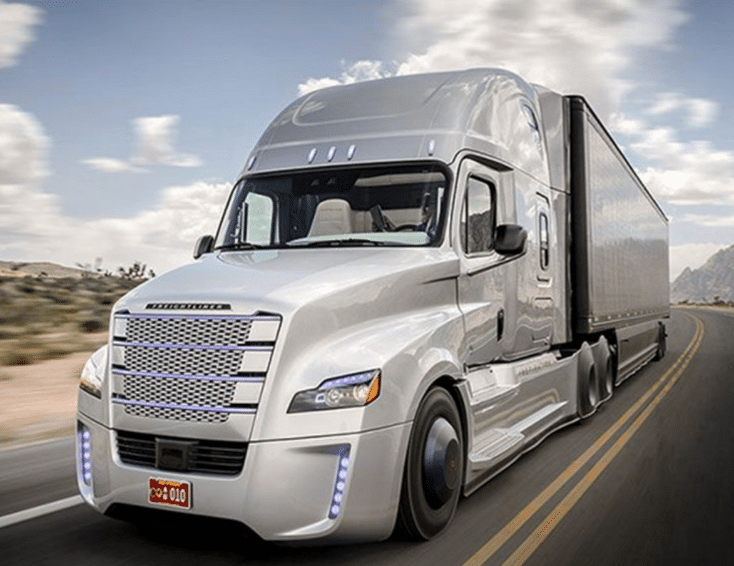
Fuel and operating optimization is the second major advantage. When a truck keeps a steady speed, avoids unnecessary braking, and accelerates smoothly, it burns less fuel and reduces wear. A widely discussed innovation add-on is platooning, where two or more trucks travel close together using coordinated control to reduce aerodynamic drag. In testing summarized by the National Renewable Energy Laboratory (NREL), maximum fuel savings reached about 5.3% for the lead truck and 9.7% for the trailing truck under certain conditions. Over thousands of miles, these adjustments have a great impact: they add up to savings for fleet operators and lower costs for the manufacturers and consumers who depend on freight.
The third benefit is higher productive uptime. Human drivers must stop for rest breaks, but autonomous trucks can drive themselves around the clock on long-haul routes, nearly doubling the available driving time. It means fast deliveries, tight schedules, and more revenue per vehicle without pushing anyone past safe working limits.
Challenges and Concerns
Regulation, jobs, and system trust are the three pressure points that decide how fast autonomous trucks can scale. It sounds abstract, but it shows up in very ordinary moments. A truck is stopped on the shoulder at night. Who places the warning triangles? Who talks to the officer? Who is “the driver” on paper if the truck is meant to drive itself?
Here are the challenges fleets and regulators run into first.
- Regulatory gaps and slow approvals. A lot of rules assume a human is sitting behind the wheel and can step outside in seconds. If the rulebook expects a person, a driverless setup has to prove it can do the same job another way, every time.
- Liability and insurance uncertainty. After a crash, someone has to answer simple questions: who controlled the truck, who maintained it, who updated the software, and who is responsible for the decision the vehicle made. If the blame can bounce between the carrier, the technology vendor, and a remote operator, most companies choose the cautious path instead of a full driverless rollout.
- Workforce disruption and retraining. Even if trucks do not replace drivers overnight, the work changes. Some roles move toward yard operations, remote support, and handling the cases that the system cannot solve on its own.
- A connected truck is a computer on wheels. Attackers can target the onboard systems, the comms link, or the cloud services behind dispatch. Strong access control, secure updates, and continuous monitoring stop being IT tasks; they are part of reliability, cybersecurity, and safety.
- Reliability in edge cases. Sunny highway miles are the easy part. The hard part is heavy rain, glare, snow, a confusing work zone, a half-visible lane line, and a sensor blocked by dirt. One headline failure sets the whole industry back, because trust is slow to earn and quick to lose.
Autonomous trucking will scale lane by lane, not all at once, because fleets and regulators will only accept systems that prove safety, day-to-day reliability, and exceptional cybersecurity in real freight work. The future upside is operational, and its hard part is execution.
Shedule a call

YOUR TRUSTED PARTNER
FOR COMPREHENSIVE FLEET
MANAGEMENT SOLUTIONS
FOR COMPREHENSIVE FLEET
MANAGEMENT SOLUTIONS
Get started
How Autonomous Vehicles Are Changing Trucking
The most predictable part of the day in trucking is the highway, but the least predictable one is everything around it: city traffic, tight docks, yard maneuvers, roadwork, and last-minute route changes. So, where does automation make sense first? Usually, a repeatable corridor runs between two terminals, where conditions can be controlled and measured.
The corridor approach impacts logistics operations more than it impacts headlines. The shift shows up in a few concrete ways:
- networks start to add transfer points, so freight can move terminal-to-terminal while local drivers cover pickup and delivery;
- dispatch becomes more standardized, because routes and driving windows are selected to match what the system can handle;
- exception handling becomes a job category: when something unusual happens, the process matters as much as the truck;
- maintenance and inspection routines expand, because sensors and computing systems join brakes and tires as must-check items.
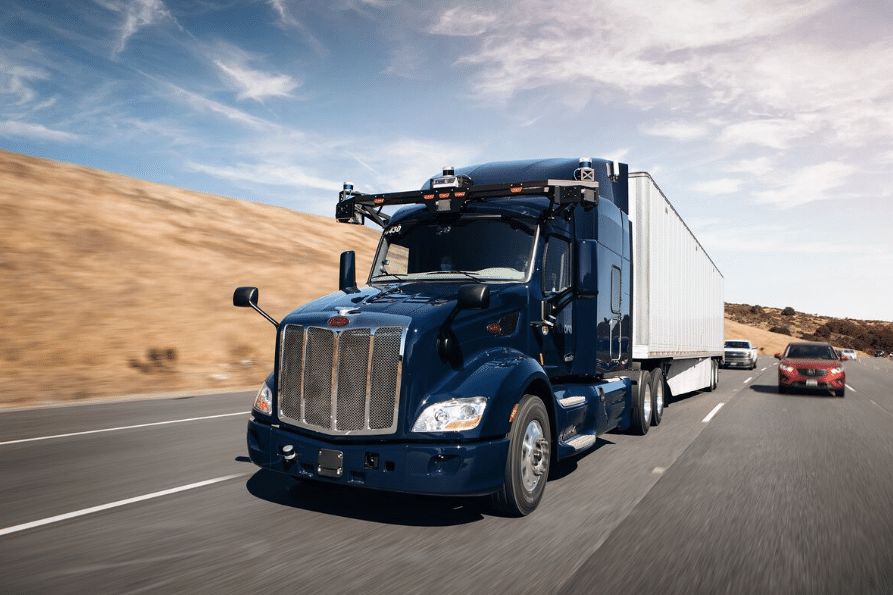
The technology stack is not the point by itself, but it explains the limits. An autonomous truck depends on sensors to observe the road (often using AI algorithms), software to decide, and cameras, radar, and lidar sensors, which form a 360-degree bubble around the truck. The important engineering choice is redundancy and safe fallback. If a sensor degrades or a computer restarts, the vehicle still needs a controlled way to slow down and stop without creating risk for others.
The industry uses a six-level scale, from Level 0 (no help at all) to Level 5 (the truck handles everything without a human). Most fleets today are testing Level 3 or Level 4, where the truck is self-driving on highways but a safety operator sits in the cab, ready to take over if the weather turns bad or traffic gets weird.
Driver assistance still expects constant human supervision and optimization. Higher autonomy shifts more of the driving task to the system, but only inside defined routes and conditions.
Conclusion
Autonomous trucks will change the industry only when automation can prove repeatable safety and everyday reliability on real freight lanes. What will not change is the role of technology in freight and transportation: it will shape routing, safety processes, maintenance, and cost control, and that will force carriers, shippers, insurers, and regulators to revise their playbooks.
The best future path is not to replace, but to coexist: drivers and transportation managers handle loading, planning, and edge cases, while autonomous trucks take on defined stretches where they can operate consistently.
Sign up for Exclusive Trucking Tips
Related Article
January 23, 2024
4232 Views
4 min read

Test